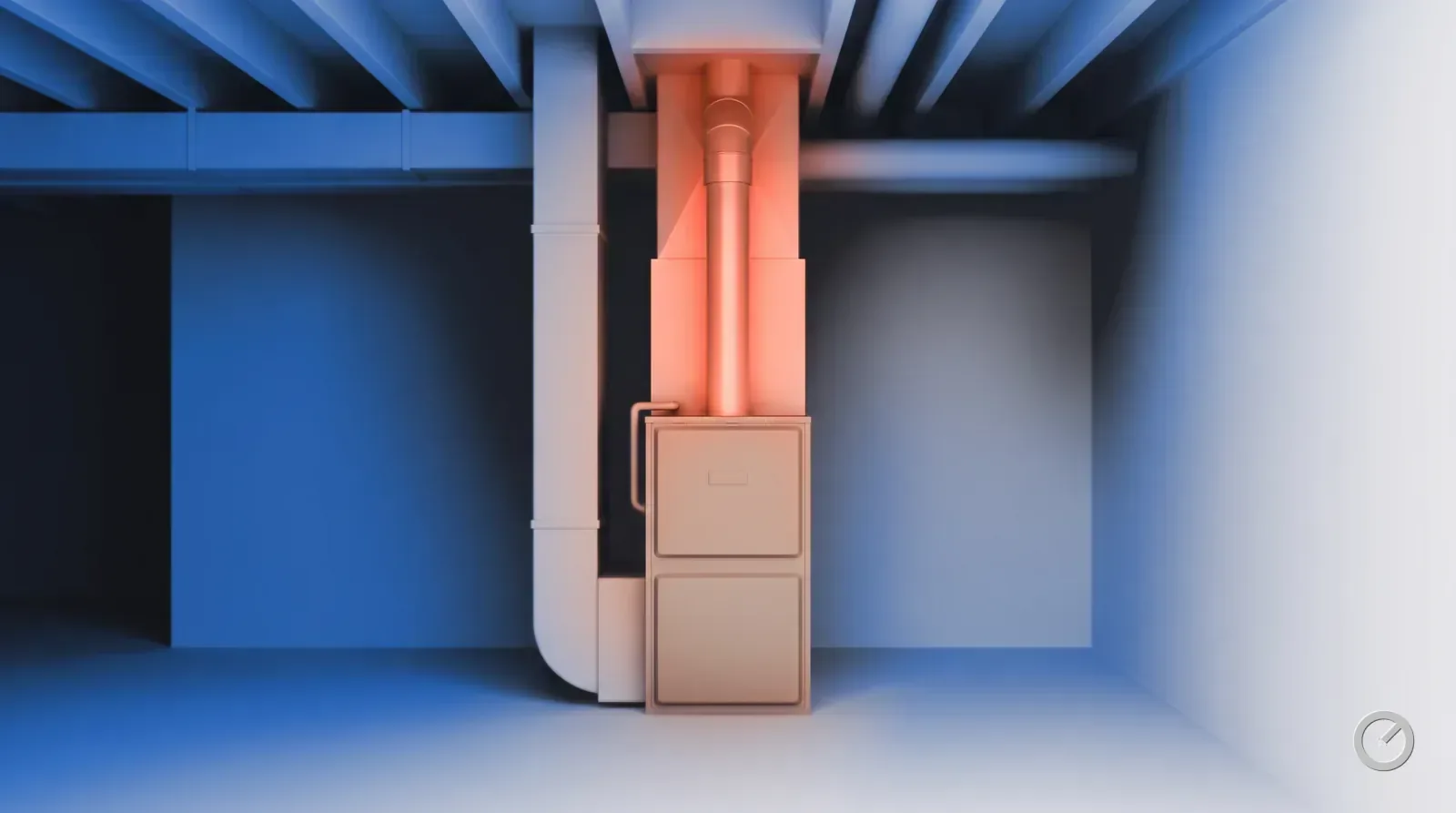
Start from the load
The heating load is the rate at which the house loses heat at the winter design temperature — the 99% design condition for your location, not the coldest night on record. In zone 5 that is around 45 BTU/h per square foot for an average envelope; the room-by-room worksheet gets closer than any per-foot number.
Heating loads are far larger than cooling loads in most of the country, because the design temperature difference is far larger: 72 degrees in Chicago against 19. That is why a house needs 100,000 BTU/h of heat and only three tons of cooling.
Output to input
A furnace nameplate carries both numbers. Input is fuel burned per hour; output is heat delivered to the air. AFUE is the seasonal ratio between them. Divide the load by AFUE to get the input you need to order:
input BTU/h = heating load ÷ AFUE

68,400 ÷ 0.96 = 71,250   →  an 80,000 BTU/h nominal furnace
68,400 ÷ 0.80 = 85,500   →  a 100,000 BTU/h nominal furnace
The same house needs a bigger box on a standard-efficiency furnace than on a condensing one, which is worth knowing before you compare two quotes with different nominal sizes.
The altitude derate
Above 2,000 feet, thinner air means a gas appliance cannot burn its full rated input. The published US rule is to derate input 4% for each 1,000 feet above sea level, so Denver at 5,280 feet costs a furnace about 21% of its nameplate. Some models specify a different figure, and the installation manual for the unit governs. The furnace size calculator applies it automatically.
High-altitude kits are a code requirement
Installing above the manufacturer's stated elevation without the correct orifice and pressure-switch kit produces incomplete combustion. The mechanical code makes the installation instructions binding, so this is not a judgement call.
Sources: Mestek/Sterling, Separated Combustion Gas-Fired Indoor Duct Furnace installation and service manual (SCDFM-3) (read 2026-10-18)
The temperature-rise check
Every furnace has a rise range stamped on the plate — the allowed difference between return and supply air temperature. Airflow, rise and output are locked together: CFM = output ÷ (1.08 × rise). A furnace producing 76,800 BTU/h at a 55 °F rise needs about 1,290 CFM.
| Output | 40 °F | 55 °F | 70 °F |
|---|---|---|---|
| 48,000 BTU/h | 1,110 | 810 | 635 |
| 64,000 BTU/h | 1,480 | 1,080 | 845 |
| 76,800 BTU/h | 1,780 | 1,290 | 1,015 |
| 96,000 BTU/h | 2,220 | 1,620 | 1,270 |
If the duct cannot deliver that airflow, the rise climbs past the top of the range, the limit switch trips and the furnace short-cycles. Measure static pressure before you decide the furnace is the problem.
Replacing an old furnace
The single worst method is matching the old nameplate. Furnaces installed before the 2000s were routinely oversized by half, and any house that has had new windows, air sealing or attic insulation since has a smaller load than it did. Calculate it fresh.
One date to plan around: gas furnaces manufactured on or after 2028-12-18 must be at least 95% AFUE, against 80% today. That means condensing, which means PVC venting and a condensate drain. If your house currently vents into a masonry chimney, that venting work is coming — doing it once is cheaper than doing it twice.
Sources: 10 CFR 430.32(e)(1)(iii) (read 2026-09-04)