How often to change your filter
CoolingIntervals by filter depth and MERV, and which way the arrow points.
7 min
The number printed on a filter frame is not what the filter measures. Search either one — the nominal size you buy or the actual size you measured — and get the match.
| Nominal (printed on the frame) | Actual (what it measures) | Where it usually goes |
|---|---|---|
| 10 × 20 × 1 | 9¾ × 19¾ × ¾ | Small return, closet air handler |
| 12 × 12 × 1 | 11¾ × 11¾ × ¾ | Ceiling return in a hallway |
| 14 × 20 × 1 | 13¾ × 19¾ × ¾ | Common wall return |
| 14 × 25 × 1 | 13¾ × 24¾ × ¾ | Furnace filter slot |
| 16 × 20 × 1 | 15½ × 19½ × ¾ | The most common size sold |
| 16 × 25 × 1 | 15½ × 24½ × ¾ | Upflow furnace, wall return |
| 18 × 20 × 1 | 17½ × 19½ × ¾ | Larger wall return |
| 20 × 20 × 1 | 19½ × 19½ × ¾ | Ceiling return grille |
| 20 × 25 × 1 | 19½ × 24½ × ¾ | Large furnace slot |
| 20 × 30 × 1 | 19½ × 29½ × ¾ | Big single return |
| 24 × 24 × 1 | 23½ × 23½ × ¾ | Commercial ceiling grille |
| 16 × 25 × 4 | 15⅜ × 24⅜ × 3½ | Media cabinet |
| 20 × 25 × 4 | 19⅜ × 24⅜ × 3½ | Media cabinet, most common |
| 20 × 20 × 4 | 19⅜ × 19⅜ × 3½ | Media cabinet, square |
| 16 × 25 × 5 | 15⅝ × 24¾ × 4⅜ | OEM media cabinet |
| 20 × 25 × 5 | 19⅝ × 24¾ × 4⅜ | OEM media cabinet |
Filters are sold by nominal size — a rounded label like 16 × 25 × 1 — but manufactured about half an inch smaller on each face so they slide into a slot cut to the nominal dimension. A "16 × 25" filter usually measures 15½ × 24½ inches. The depth is undersized too: a one-inch filter is ¾ of an inch thick, a four-inch is 3½.
That is why a tape measure across the old filter gives you the actual size and the shop sells you by the nominal. Search either column above and the row lines them up.
The previous filter may have been wrong
If the filter in the slot has bent corners, a crushed frame or a gap you can see light through, it is the wrong size and has been bypassing air around itself. Measure the slot opening with the filter out, subtract nothing, and buy that nominal size.
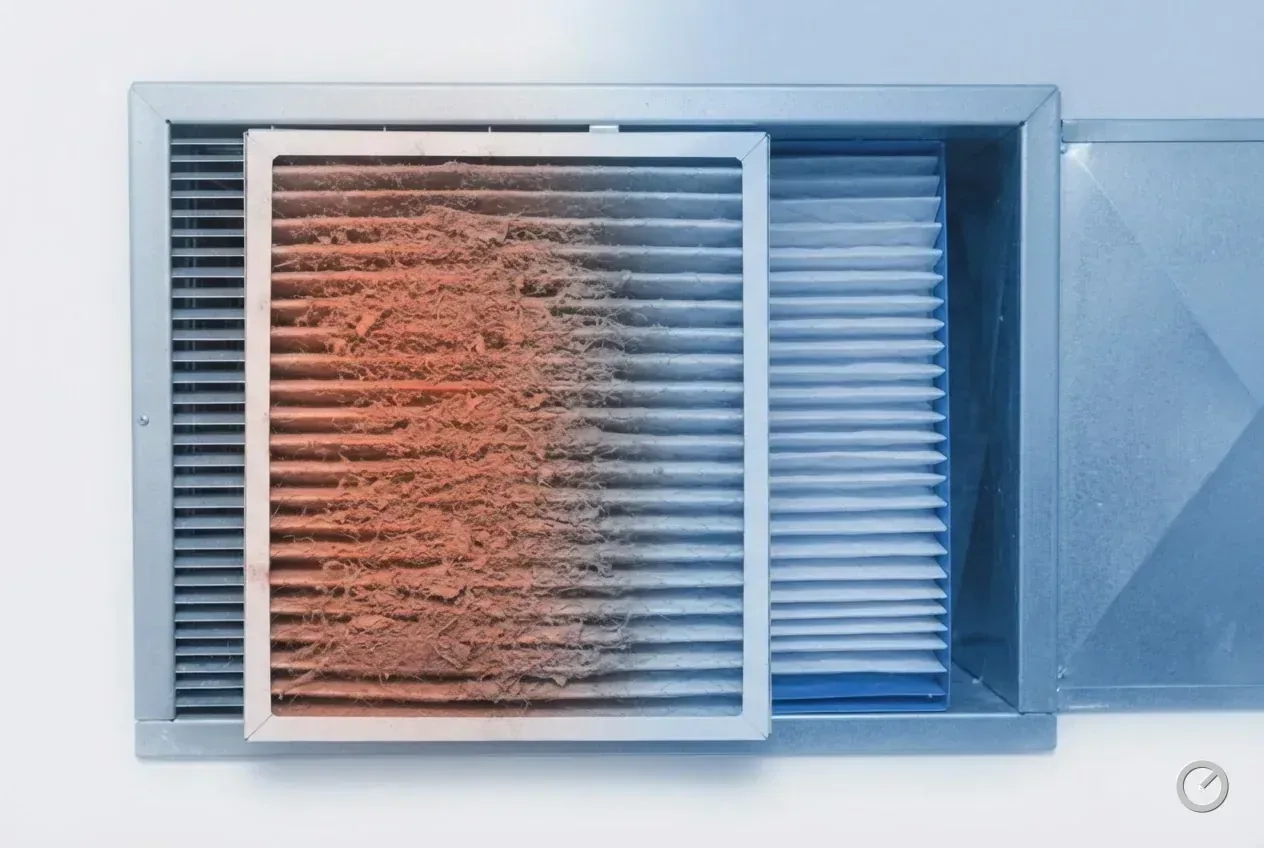
A filter that is slightly too small is worse than no filter at the same MERV: the air takes the gap, the coil still loads up, and you have paid for filtration you are not getting.
Media area, not rating, decides pressure drop. A four-inch pleated filter has several times the media surface of a one-inch filter of the same face size, so it can hold a higher MERV rating at a fraction of the resistance and last three to six months instead of one or two.
If your system has a one-inch slot and high static pressure, converting to a four-inch media cabinet is usually the cheapest fix available — cheaper than a blower, and it solves the filtration argument at the same time. Check the current reading first with the static pressure calculator.
EPA's guidance when upgrading a furnace or HVAC filter is at least MERV 13, or as high a rating as the system's fan and filter slot can accommodate. The second half of that sentence is the part people skip — see the MERV chart for what each rating actually captures.
Sources: US EPA, Indoor Air Quality — What is a MERV rating? (read 2026-09-04)
Intervals by filter depth and MERV, and which way the arrow points.
7 min
MERV 1–16 against particle size, pressure drop and what each rating catches.
MERV 1–16
Capture rate against pressure drop — what a MERV 13 costs your blower.
MERV · in. w.c.
Heat recovery with and without moisture transfer, by climate zone.
% recovery
More in Service & Costs — 6 tools, 6 guides, on SetpointKit. Or browse every HVAC calculator.