Gas furnace
Federal minimum
$16.68 per MMBtu delivered at 80% AFUE
An electric furnace turns essentially all its energy into heat and is still, at U.S. average prices, roughly three times as expensive to run as a gas furnace that wastes a fifth of its fuel. Efficiency is not price.
Updated 2026-10-18
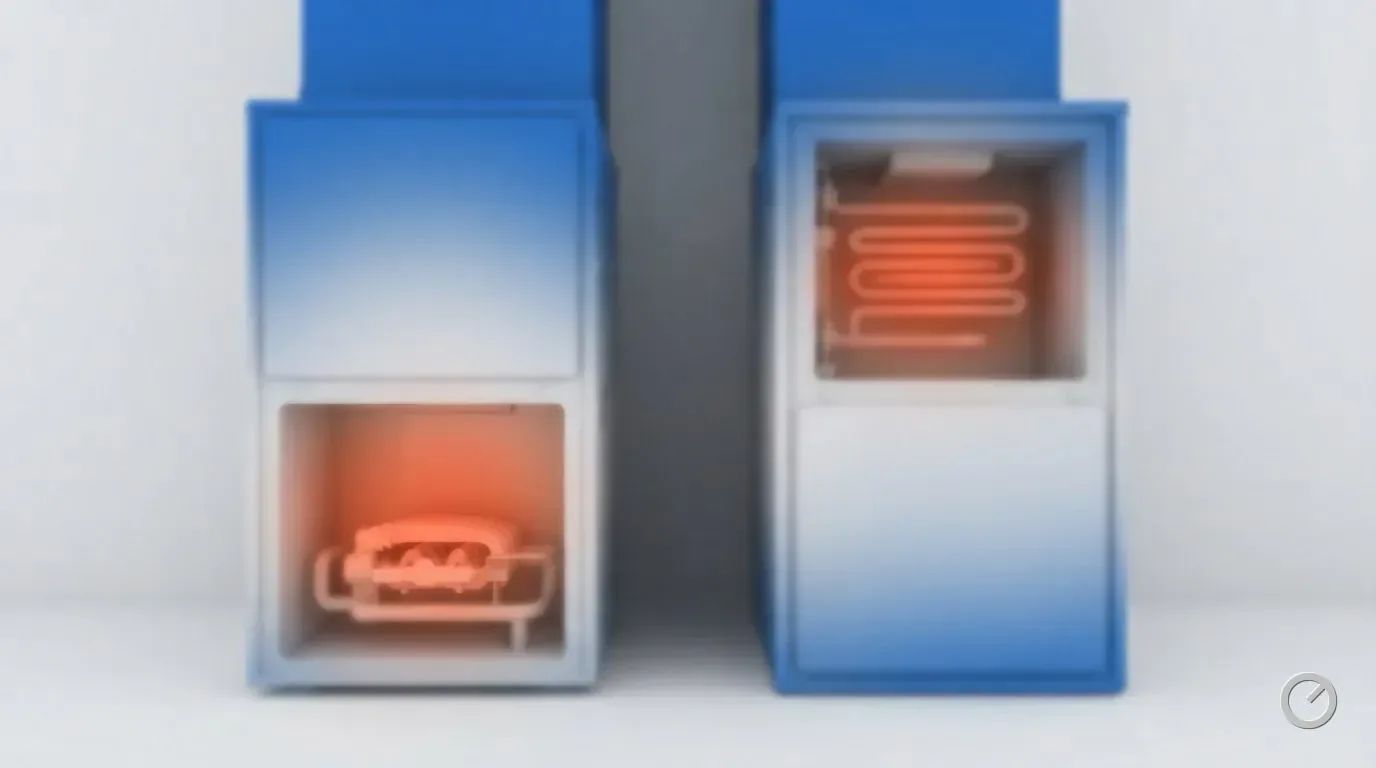
Our pick — gas where a meter exists; a heat pump rather than an electric furnace where one does not
Federal minimum
$16.68 per MMBtu delivered at 80% AFUE
Conversion efficiency
$53.66 per MMBtu delivered at 100% (resistance)
Because efficiency is a ratio and price is a rate. A therm of natural gas and a kilowatt-hour of electricity are both energy, but at the U.S. residential averages one million BTU costs about $13.35 as gas and $53.66 as electricity — before either appliance touches it.
Divide the gas figure by the furnace's AFUE and it still lands far below the electric one. That gap is the whole comparison, and it is why electric resistance heat survives mainly where there is no gas meter and no room for a heat pump.
| Factor | Gas | Electric |
|---|---|---|
| Federal minimum | 80% AFUE | 78% AFUE (test-procedure figure) |
| Cost per delivered MMBtu | $16.68 | $53.66 |
| Install complexity | Gas piping, venting, combustion air | Large electrical feed and breaker |
| Electrical load | One 15 A blower circuit | Often 60–100 A of resistance elements |
| Combustion safety | CO risk; annual inspection recommended | None |
| Typical lifespan | 15–20 years | 20–30 years — few moving parts |
| Maintenance | Burners, exchanger, venting, gas pressure | Filter, blower, element continuity |
| Sensible upgrade path | Condensing furnace, or dual fuel | A heat pump using the same air handler |
If you are considering an electric furnace, price a heat pump first
A heat pump uses the same air handler cabinet, the same duct, and the same electrical service — and delivers two to three times the heat per kilowatt-hour. Electric resistance makes sense as supplemental heat below a heat pump's balance point, or in a small space where the equipment cost of a heat pump cannot be justified. As a whole-house primary heat source with a heat pump available, it rarely does.
The one place electric resistance is genuinely the right answer: a small addition or an accessory unit where the load is tiny, the run hours are few and the installed cost of anything else dominates. There, the running-cost gap is real but small in absolute dollars.
Sources: 10 CFR 430.32(e)(1)(ii)(G) (read 2026-09-04) · EIA Electric Power Monthly, Table 5.6.A (released 2026-09-24) (read 2026-10-18) · EIA series N3010US3M, U.S. price of natural gas delivered to residential consumers (released 2026-08-31) (read 2026-09-04)
Hot water or warm air: federal AFUE floors, cooling, air quality and service.
% AFUE
Annual heating cost from AFUE, fuel price and load — gas against electric.
$/yr · AFUE
What annual fuel utilization efficiency measures, and the federal minimums.
8 min
Running cost, install cost and capacity at design temperature, side by side.
HSPF2 vs AFUE
More head-to-heads in the HVAC equipment comparisons index.