Heat pump
Seasonal efficiency
$21.54 per MMBtu delivered at HSPF2 8.5
One moves heat, one makes it. That difference decides the running cost, the electrical service, the venting, and what happens on the coldest night of the year.
Updated 2026-10-18
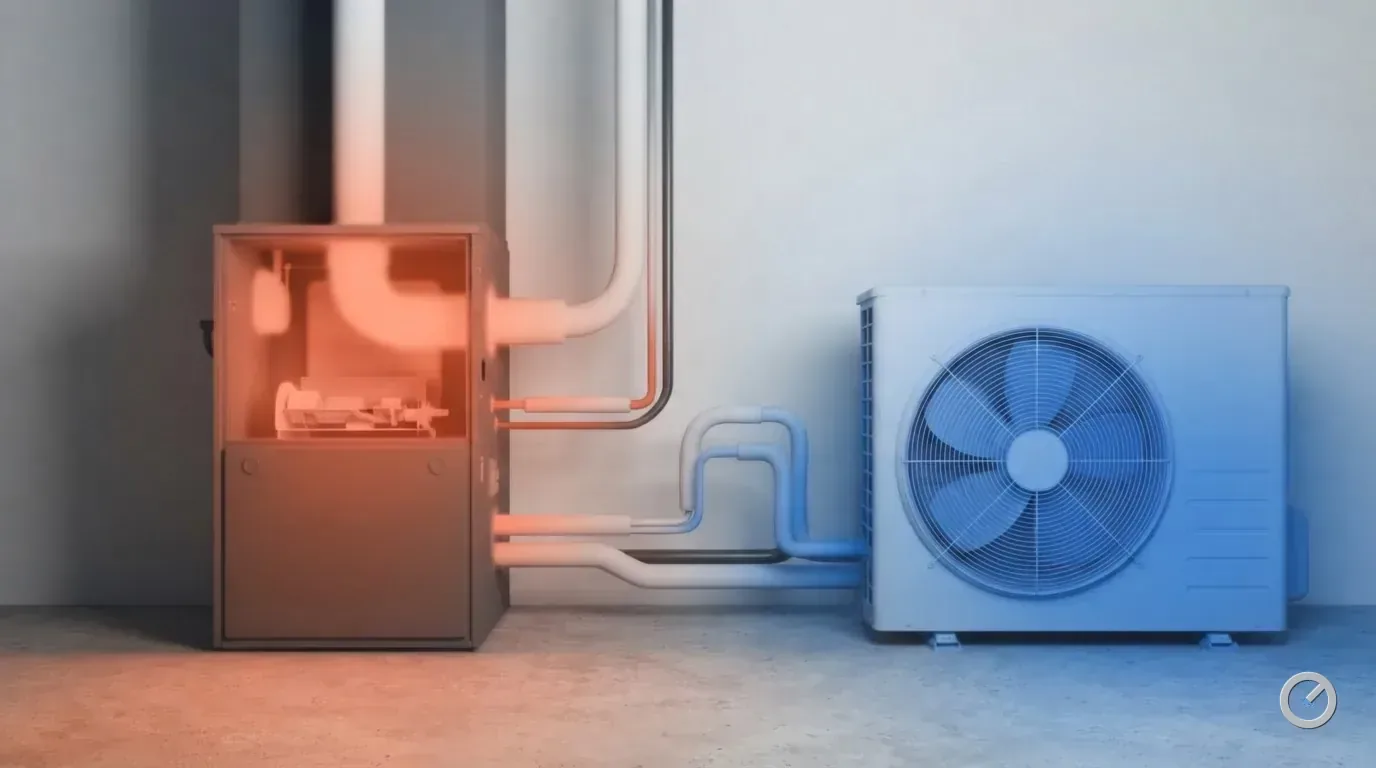
Our pick — a heat pump where power is cheap or gas is absent; dual fuel where both are available and winters are long
Seasonal efficiency
$21.54 per MMBtu delivered at HSPF2 8.5
Seasonal efficiency
$14.05 per MMBtu delivered at 95% AFUE
They are not the same scale, which is the whole problem with this comparison. HSPF2 is BTU delivered per watt-hour; AFUE is a percentage of fuel energy. The only fair comparison is the line underneath each dial: dollars to put one million BTU into the house, computed from the same two energy prices.
At the U.S. residential averages — 18.31 ¢/kWh and $13.84 per Mcf for the 2025 heating season — gas wins on running cost. Change either price and the ranking can flip; the fuel cost calculator takes your own numbers.
| Factor | Heat pump | Gas furnace |
|---|---|---|
| Also does cooling | Yes — one machine, both seasons | No; needs a separate condenser |
| Capacity in deep cold | Falls with outdoor temperature | Constant to the design point |
| Efficiency metric | HSPF2, minimum 7.5 | AFUE, minimum 80% |
| Cooling metric | SEER2, minimum 14.3 | n/a |
| Venting | None | Flue or PVC, plus combustion air |
| Electrical | Often a service or panel upgrade | A 15 A circuit for the blower |
| Gas meter | Can be abandoned | Required, with its fixed monthly charge |
| Combustion safety | No CO risk from the appliance | Heat exchanger and venting must be inspected |
| Cold-night behaviour | Supplemental heat below the balance point | Full output at design |
Heat pump. Anywhere electricity is cheap relative to gas — much of the Pacific Northwest and the Southeast — and anywhere there is no gas meter, where the alternative is propane, oil or resistance heat. Also anywhere the cooling system is being replaced anyway, because a heat pump costs little more than the condenser it replaces.
Gas furnace. Cold climates with cheap gas, houses with a tight electrical service, and any situation where the coldest week of the year matters more than the average one. A furnace does not care that it is −10 °F outside.
Dual fuel is the third answer
A heat pump above the balance point, a gas furnace below it, and a thermostat that switches between them. It costs more to install, keeps both fuel connections, and in a long cold winter with both fuels available it is usually the cheapest to run — and it avoids the electrical upgrade a strip-heat package forces. Find your balance point with the sizing calculator.
Sources: 10 CFR 430.32(c)(5)(ii) (read 2026-09-04) · EIA Electric Power Monthly, Table 5.6.A (released 2026-09-24) (read 2026-10-18) · EIA series N3010US3M, U.S. price of natural gas delivered to residential consumers (released 2026-08-31) (read 2026-09-04)
Same cooling cycle plus a reversing valve: SEER2 floors, indoor pairing and dual fuel.
SEER2 vs SEER2
Capacity at design temperature, balance point and the supplemental-heat gap.
BTU/h · balance point
Capacity at 5°F, balance points, and when a dual-fuel setup wins.
11 min
Annual heating cost from AFUE, fuel price and load — gas against electric.
$/yr · AFUE
More head-to-heads in the HVAC equipment comparisons index.