Static pressure explained
Sizing & LoadWhat total external static pressure is, how to read it, and what a high number costs.
9 min
Two probe readings become one number: total external static pressure, how it compares to what the blower was rated for, and the friction rate that is left for the duct system.
Pre-filled with a typical over-pressure reading: 0.42 supply, −0.38 return against a 0.5 in. w.c. rating.
On the nameplate; most residential air handlers are 0.5.
Longest supply run plus longest return run, fittings counted as equivalent feet.
Total external static
160% of the rated 0.5 in. w.c. envelope — well over the rating — the blower is choked.
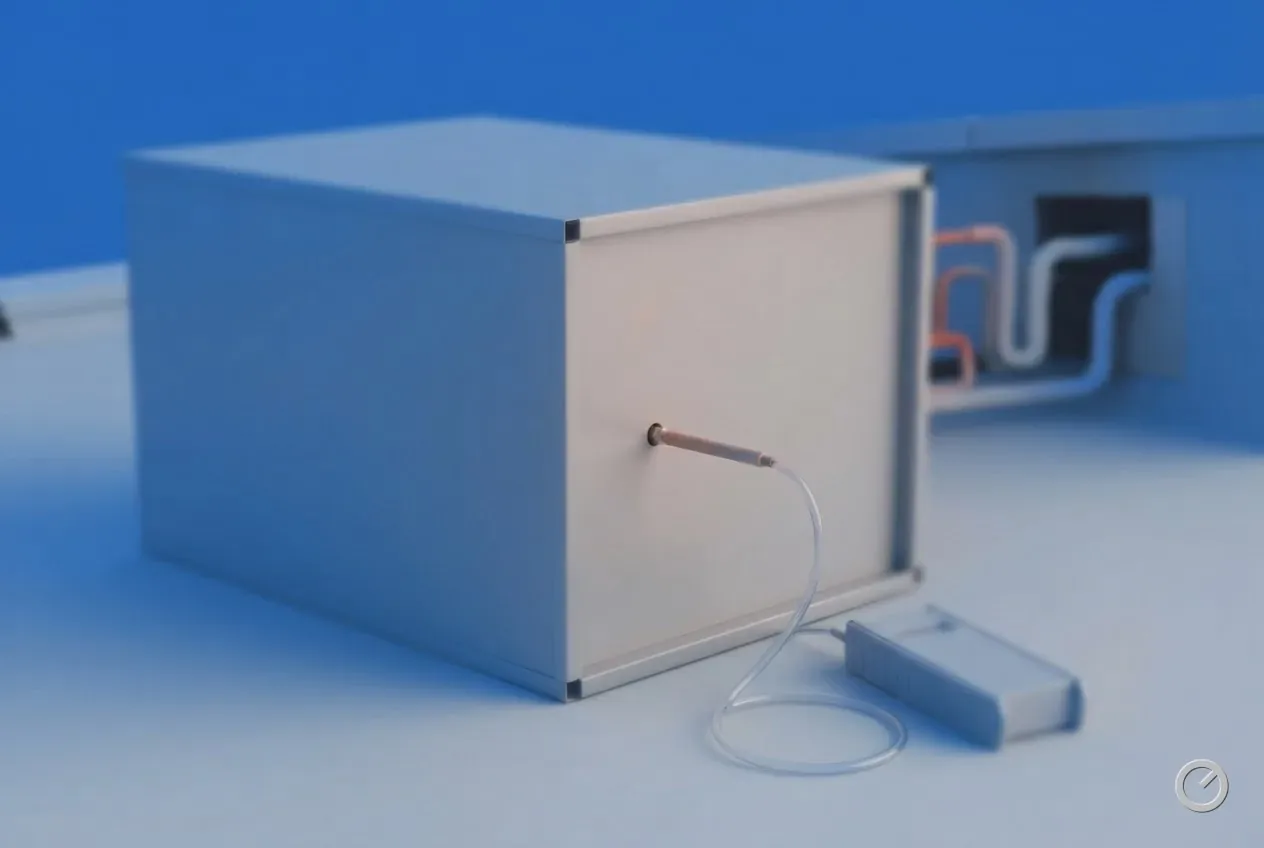
Total external static pressure is the pressure the blower has to fight to move air through everything outside itself. You measure it with a manometer and two static pressure tips: one in the supply plenum downstream of the coil, one in the return before the filter. The supply reading is positive, the return negative; TESP is the sum of the two absolute values.
Drill the test ports where the air is going straight — at least a few inches from a bend, a take-off or the coil face. A tip in turbulent air gives a reading that moves as you watch it.
What you are measuring is defined: the pressure at the design fan airflow inclusive of the external components — evaporator coil, whole-house humidifier, a MERV 6 or better filter. That is why a deeper filter or a wet coil moves the reading and why the number has to sit below the equipment's own limit.
Safety — Live equipment
Taking static pressure means running the blower with panels off and a drill near a cabinet. Kill power at the disconnect before you drill, and stay clear of the electrical compartment when the unit is running. On a gas furnace, do not drill into a flue passage or a sealed combustion chamber.
Those two readings are the field procedure verbatim: return-side and supply-side external static pressure, taken at the test locations the installing contractor provides, recorded in inches of water column. It is one of the numbers a third-party rater writes down on a certified house.
Sources: EPA ENERGY STAR, National Rater Field Checklist v3.1/3.2/3.3 (Rev. 14, revised 2025-01-15), Item 5b.2 and Footnote 23 (read 2026-09-04)
| TESP | Of rating | What it means |
|---|---|---|
| 0.20–0.35 | 40–70% | Low. Check the probes are in the airstream and not reading zero. |
| 0.40–0.55 | 80–110% | Normal. The blower is delivering close to rated airflow. |
| 0.60–0.80 | 120–160% | Restricted. Airflow is down, capacity with it. |
| 0.85+ | 170%+ | Choked. Expect frozen coils in summer and limit trips in winter. |
A high reading is not the blower's fault. It is a filter that is too restrictive for its slot, a coil packed with dust, an undersized return, or flexible duct that was never stretched. Fix the restriction; do not increase the blower speed to hide it.
The right-hand panel does the design step. Take the blower's rating, subtract the measured coil and filter drops, and you have the static pressure available for duct. Divide that by the total effective length of the longest supply-plus-return path, multiply by 100, and you have the friction rate in inches of water column per hundred feet — the single number the duct size calculator needs.
With the defaults above: 0.50 rated, minus 0.22 coil, minus 0.18 filter, leaves 0.10 in. w.c. for 150 equivalent feet — a friction rate of 0.067. That is a system whose filter and coil have eaten most of the budget, and it is why the duct feels undersized even when it was drawn to 0.08.
Dividing by total effective length rather than tape-measure length is the whole point: the Manual D friction-rate method takes the equivalent length of the system, and that equivalent length is itself a function of the design velocity.
Sources: EPA ENERGY STAR, National HVAC Design Report v3.1/3.2/3.3 (Rev. 14, revised 2025-01-15), Item 5.1 (read 2026-09-04) · DOE Building America Solution Center, Air Conditioning (read 2026-09-04) · DOE Building America Solution Center, No Kinks or Sharp Bends in Flex Duct Installation (read 2026-09-04)
A one-inch pleated filter in a slot sized for fibreglass is the most common single cause of high static in a house. The fix is a deeper filter with more media area, not a cheaper filter with less filtration — a four-inch media cabinet at the same MERV rating drops a fraction of the pressure because the face area is several times larger. The MERV 8 against MERV 13 comparison puts numbers on that trade.
What total external static pressure is, how to read it, and what a high number costs.
9 min
Round and rectangular duct sizes from CFM and friction rate, with equivalent diameter.
CFM · in. w.c./100 ft
CFM per ton, friction rate, and the duct calculator method step by step.
10 min
Friction, bends, support spacing, sag and leakage, and where each belongs.
in sag · ft span
More in Sizing & Load — 8 tools, 4 guides, on SetpointKit. Or browse every HVAC calculator.